A year with WurQ
Five hurdles before the WOD, five more after, and I’m still logging.
A year with WurQ
I’ve been trying WurQ on and off for a year. I got into their beta last September, and in October two little sensors showed up: one for my wrist, one for my chest. You start a session in the app, train as usual, and it figures out which movements you did, counts the reps, and shows you where you rested and where your pace dropped. Today it’s $15 a month with the hardware included.
For CrossFit this is a big deal. My Apple Watch sees a WOD as heart rate and calories. WurQ sees thrusters and pull-ups. In June, CrossFit made it their official performance analytics partner.
So I want this to work. I also build PRzilla, a CrossFit training app, which means I spend my days on the same problem from the other side. Take what follows as notes from a paying customer who’s rooting for them.
After a year, my take is that it’s a good idea that isn’t ready for daily training. Too many things have to go right before and after class, and it still asks the sensors to guess the workout the whiteboard already knows.
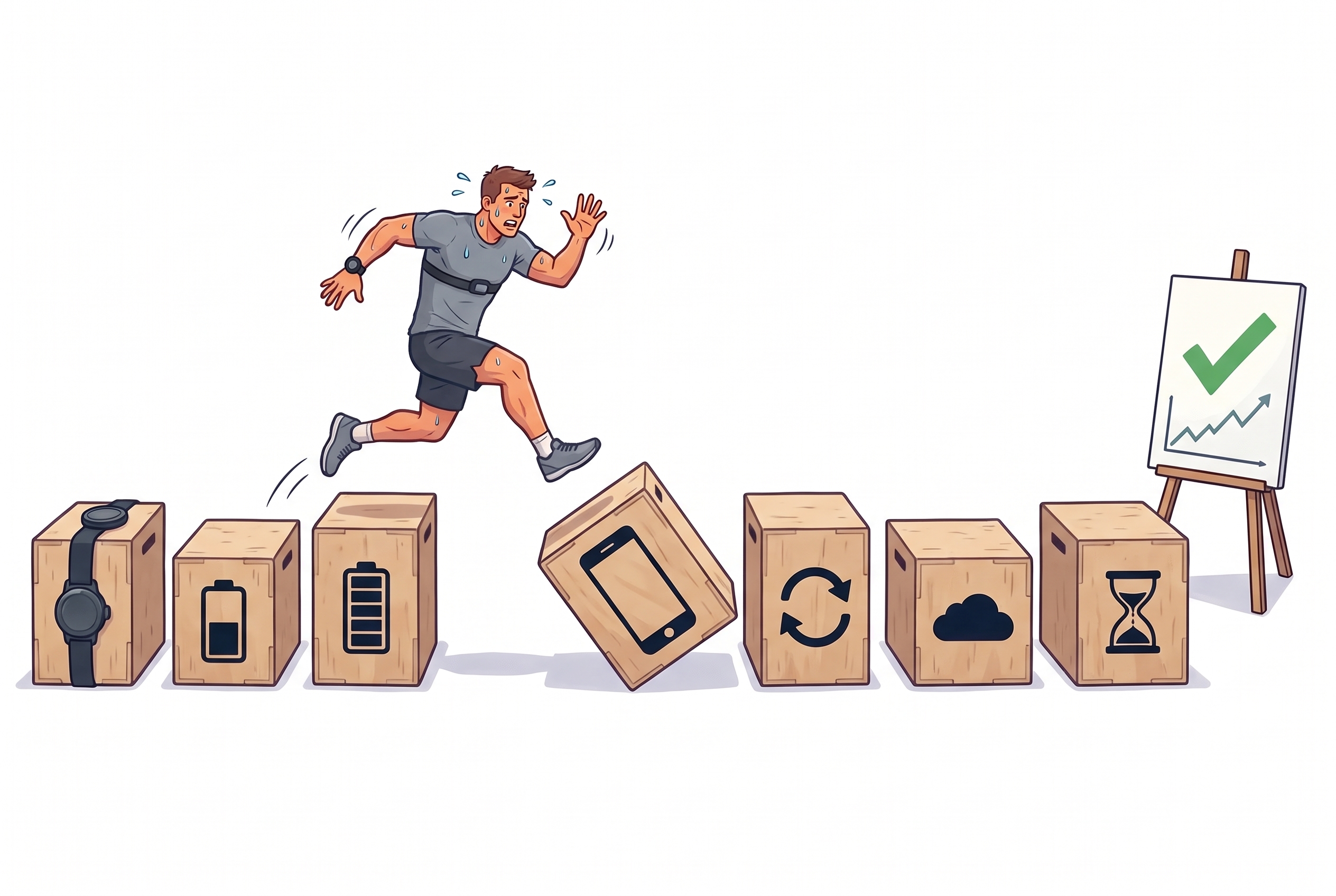
The buy-in
In CrossFit, a buy-in is the work you have to get through before the real workout starts. WurQ has one, and you do it every class:
One more device. That’s a lot to ask when most of us already wear an Apple Watch or a Whoop.
Two straps. Say you get it anyway. You now have to wear both sensors, wrist and chest, every time.
Two batteries. Each sensor has its own, and they aren’t rechargeable: a dead one has to be replaced. They tend to run out at the worst moment, which is when you walk into the gym.
A connection that holds. If both batteries are alive, sometimes the connection isn’t, and you find that out just as the class is about to start the WOD.
A phone, found before 3-2-1-go. You have to remember to start it. WurQ records the metcon, not the whole class: the strength and skill work isn’t tracked at all. I can’t just hit start when I walk in, so I have to go find my phone right before we begin. More than once I forgot, with both straps already on.
None of these is a dealbreaker on its own, but any one of them is enough to leave you with no data that day.
WurQ announced Gen 2 in June: rechargeable sensors, a charging case, better connectivity, and an upgrade for early members at the cost of shipping. They said it would ship in September; mine hasn’t shipped yet. It should fix the batteries and perhaps the connection. The rest of the buy-in stays.
The buy-out
CrossFit has a buy-out too: the work you still owe after the main part is done. So does WurQ:
A sync from the sensors to the phone. You press stop, and the data first has to get from the sensors to your phone. That step is slow, and the phone has to stay next to the sensors while it runs. If you’re wiping down the floor or talking to a coach, the phone has to come with you in a pocket. Otherwise you sit there holding it until it’s done.
An upload to the server. After that the phone sends everything to the server, which takes a while on a weak connection.
A wait. The server processes it. Only then do you see your workout.
The weights, typed in by hand. After all that, WurQ still doesn’t know the weights, and it needs them to estimate my power output. A motion sensor knows I did a clean. It doesn’t know what was on the bar, or whether I did the workout as prescribed, so I type that in.
One more log. WurQ doesn’t send the workout anywhere else, so it goes in a second time, into the app where I track everything else. That makes one more place where my workout lives.
Steps 4 and 5 are the odd part. To me, the appeal of a sensor is that I put it on and stop worrying about logging every set and rep. WurQ’s product page makes the same promise: “Say goodbye to manually logging your WOD!” So far it’s a half-kept one: I’m still logging.
It guesses what I could just tell it
Most of what we do in class isn’t a named benchmark. It’s whatever the coach wrote on the whiteboard that morning. About 80% of the time I start a “freestyle” workout and let WurQ work out what I did from how I moved.
Here’s one from last week’s drop-in at CrossFit 7x7:
“Whet”
2 rounds for time:
100m farmer carry
10 SA DB squat cleans (R)
10 SA DB OH walking lunges (R)
10 SA DB devil presses (R)
5 bar muscle-ups
50 cal row
5 bar muscle-ups
10 SA DB devil presses (L)
10 SA DB OH walking lunges (L)
10 SA DB squat cleans (L)
100m farmer carry
First, WurQ asks what kind of workout it was: rounds for time, or a chipper? This one is two rounds for time, and each round is a chipper. I have to translate my workout into their categories before I can log it, and more than once that made me stop and think. That’s not what I want to be doing after a workout.
There’s also what it can’t see. WurQ got the right-arm half of this workout correct. For the left-arm half it saw lunges and something like a burpee. There’s no sensor on my left wrist, so it had no way of knowing I was cleaning a dumbbell.
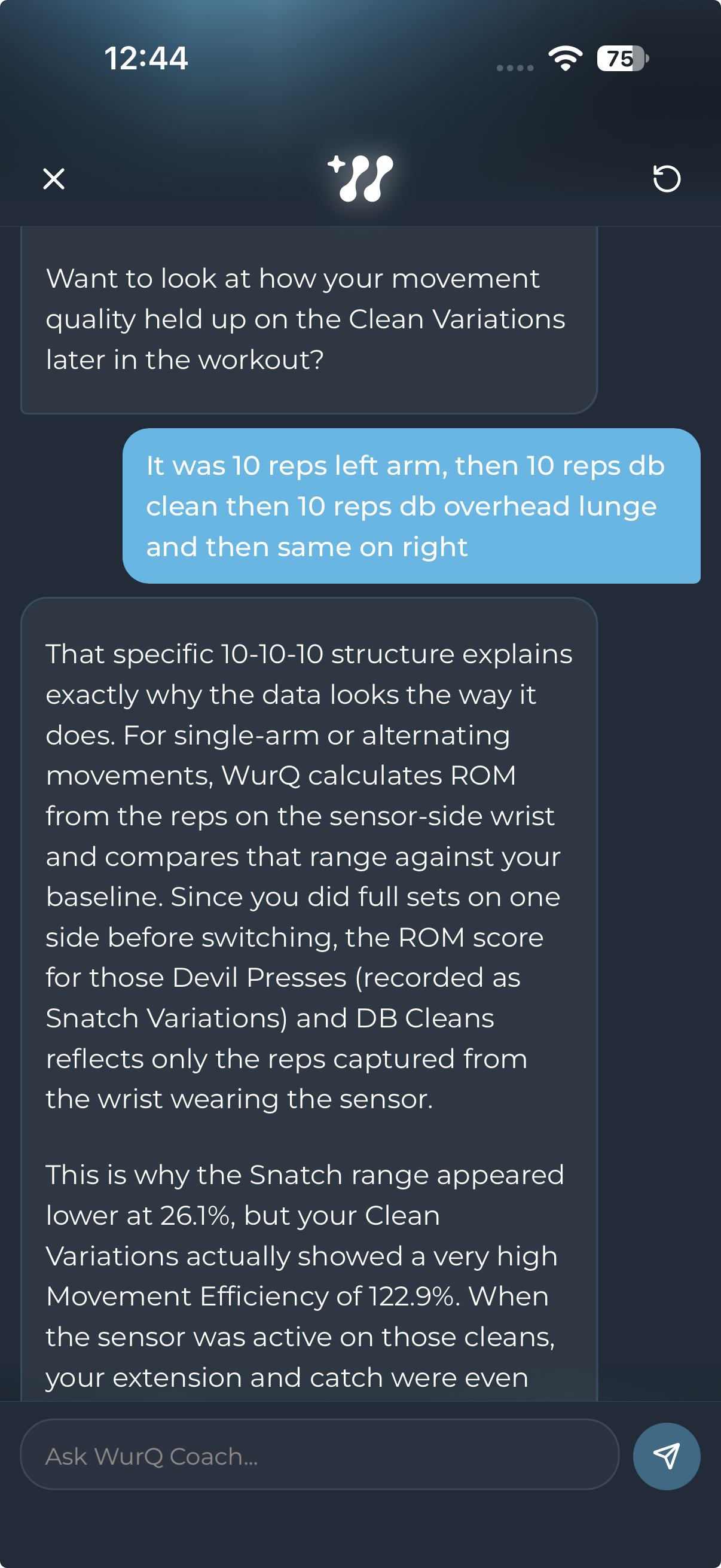
CrossFit is extremely varied, and I know from building in this space how hard it is to model. I run into the same problems. But inferring a whole workout from movement patterns alone makes the problem harder than it needs to be.
None of this needed guessing. The workout was on the whiteboard. I could have just typed it in, the way we do in PRzilla: type or paste the workout, and it becomes structured movements, sets and reps.
When something goes wrong, support has asked me for the “ground truth”: what the workout actually was. That’s the one thing I’d rather give them up front.
So flip it around. Ask me what I did, or pull it from my gym’s whiteboard, and then lay the sensor data on top.1 Let me say “I did this one Rx” and skip the weight grid. The app already has programs where the workout is known in advance: WurQ’s own challenges, and HWPO’s Flagship 2.0 if you have an access code. I want that for the workout I’m actually doing today.
With the workout known, the app no longer has to guess the movement label from scratch. The sensor can tell me what no whiteboard can: how fast the reps were, where I rested, when I slowed down. When the workout says “10 SA DB squat cleans (L)”, it could show those cleans as prescribed and mark the left-arm reps unverified, rather than calling them burpees.
The whiteboard knows the workout. The sensor should tell me how I did it.
What they got right
The rep tracking is useful when I want to see where I slowed down during a workout or compare two attempts at the same WOD. That’s something my watch can’t tell me.
Entering weights in WurQ is nicely done: type one, and apply it to every set of that movement. I liked it enough to borrow it for PRzilla.
The AI breakdown is the best thing in the app. It reads my sessions and gives me an explanation I can actually use, like what happened to my movement later in a workout. That’s more useful to me than looking at work-volume charts and efficiency percentages on the home screen.
Would I recommend it?
Not in its current form. It isn’t ready for most people yet. It reminds me of a first muscle-up: you get over the rings, chicken wing and all, and it counts. It’s just not pretty yet.
Where I’d still use it is a specific test: an Open workout, or a benchmark where I really want to understand my performance. For day-to-day training it’s too much work for what I get back.
What I’d love to see is WurQ built into daily training: it knows my programming, logs everything automatically, asks me only the questions that matter, and gives me the insights without my having to dig for them.
WurQ is almost a GPS for my body: it knows my movements and my range of motion. Once the basics work, I’d love to import that data into PRzilla or any other app where people keep their training, the way I can import a run from my watch.
The idea is right. CrossFit should have a sensor that knows a thruster when it sees one. I’m still rooting for Gen 2.
Other teams are trying different approaches. Morph captures workout video at participating gyms. WODMotions uses a sensor for athlete testing rather than logging each daily WOD. I haven’t used either.
Originally published on Substack on October 7, 2026.